
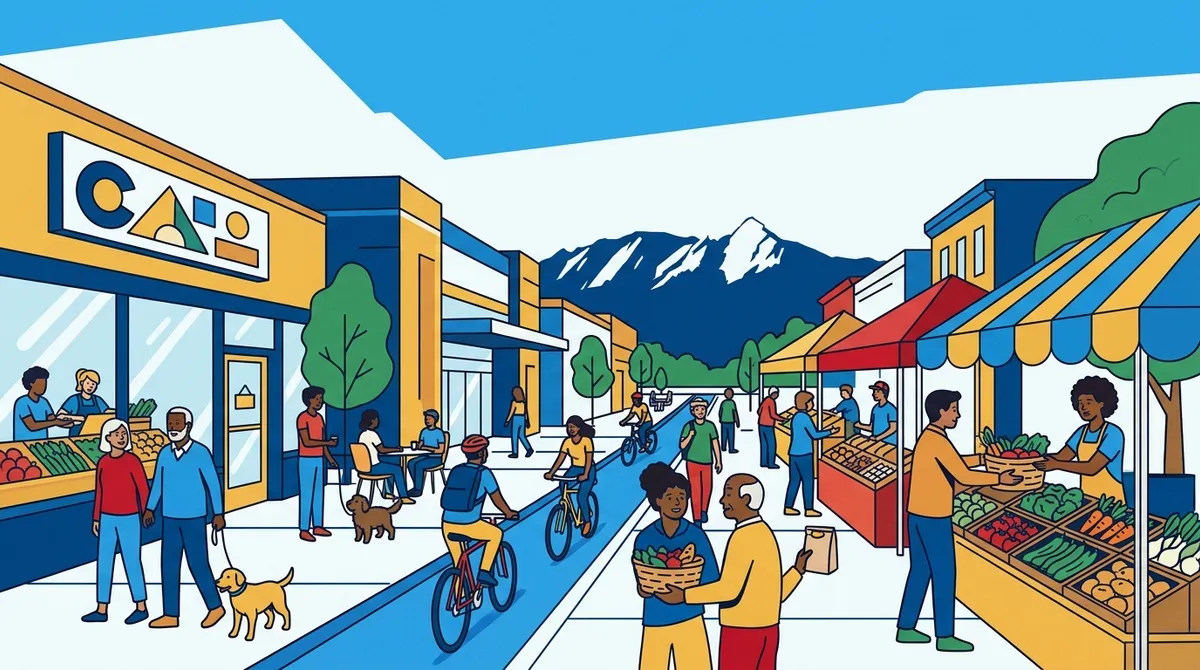
Worker Cooperative Development: The Solidarity Economy
Fund worker-owned businesses, convert retiring owners' companies to employee ownership, and prioritize cooperatives in city contracting. Build an economy where workers own what they build.
- Drafted
- Organizing
- Introduced
- Committee
- Enacted
The Problem
Denver’s economy produces extraordinary wealth. Most of it leaves Denver.
Corporate chains extract revenue from Denver’s neighborhoods and distribute profits to shareholders in New York, Los Angeles, and abroad. Private equity firms buy up local businesses, cut costs, extract fees, and often leave the businesses in worse condition than they found them - or close them entirely. Small business owners who spent decades building something retire with no buyer and lock the doors, destroying jobs and community institutions.
Meanwhile, the workers who actually create that value - who bake the bread, drive the trucks, care for the elderly, maintain the buildings - have no ownership stake in what they build. They are employees at will, subject to layoffs, wage cuts, and relocation decisions made by people who have never set foot in Denver.
This is not the only way to organize an economy. Worker cooperatives - businesses owned and democratically controlled by their employees - have existed for centuries and currently employ millions of people worldwide. The evidence is clear: they are more stable, more equitable, and more resilient than conventional firms. And they keep wealth in the communities where it is created.
Denver has the legal infrastructure to support them. Colorado’s 2024 Worker Cooperative Corporations Act created a clear legal framework. What is missing is the public investment to build the ecosystem.
The Succession Crisis
The most immediate opportunity is also the most urgent: the baby boom retirement wave. The oldest of the baby boomers are in their late 70s. Millions of small business owners built companies over decades and now face retirement with no obvious buyer. Nationwide, an estimated 10 million businesses owned by boomers will need a succession plan in the next decade (Project Equity, 2023). In the Denver metro area, that is an estimated 70,000 businesses.
Most will simply close. Some will sell to private equity or large competitors. A tiny fraction will pass to family members. The workers who built those businesses will be laid off, and the economic assets their labor created will be destroyed or extracted.
Worker buyouts - where employees purchase the business through a combination of financing and seller financing - are a proven alternative. They have been executed successfully across industries: manufacturing, homecare, grocery retail, professional services, construction. The barriers are not technical. They are financial access and technical assistance.
Cooperatives and Racial Economic Justice
Worker cooperative development is inseparable from racial economic justice in Denver. Black and Latino workers are overrepresented in the industries - homecare, food service, janitorial, construction - where worker cooperative models have the most transformative potential. They are underrepresented in business ownership and in asset-building generally.
A cooperative economy, built in partnership with BIPOC communities, is a direct mechanism for closing the racial wealth gap - not through charity, but through ownership.
Our Solution
1. Denver Cooperative Development Fund
Create a $20M Denver Cooperative Development Fund (CDF) administered by the Denver Office of Economic Development, providing:
- Startup grants of up to $50,000 for new worker cooperative formation, with priority for cooperatives in industries with significant workers of color (homecare, food service, cleaning services, construction).
- Technical assistance grants covering business planning, legal formation, governance training, and financial literacy for cooperative workers.
- Loan guarantees for worker-cooperative business acquisition loans (the biggest financing barrier in worker buyouts).
- Low-interest acquisition loans at below-market rates, subordinated to senior commercial debt, to make worker buyout financing competitive with private equity offers.
The fund is capitalized through a combination of city general fund appropriation ($8M), federal Economic Development Administration grants ($7M), and CDFI investment (~$5M).
2. Business Succession Program - Convert Before They Close
Partner with Denver’s Small Business Development Center, SCORE, and industry associations to proactively identify retiring business owners and offer worker conversion as a succession option.
The program provides:
- Free succession planning consultations for business owners over 60 with no current succession plan.
- Worker readiness assessments - working with current employees of identified businesses to gauge interest and readiness for cooperative ownership.
- Seller financing incentives - state tax credits for business owners who sell to their employees on favorable terms, modeled on Colorado’s 2024 WCEA (pending extension).
- Deal facilitation - a city-funded team of cooperative development specialists who can move a sale to worker ownership from concept to close.
Target: 50 worker cooperative conversions in the first four years, preserving an estimated 1,500-2,500 jobs that would otherwise be at risk.
3. Cooperative Preference in City Contracting
Denver contracts annually for hundreds of millions of dollars in goods and services: cleaning, food service, construction, IT, homecare. Amend Denver’s Purchasing Rules to:
- Award 5% bid preference to worker cooperatives and employee-owned firms on city contracts, equivalent to the existing local preference.
- Require that Requests for Proposals (RFPs) for personal services contracts (homecare, cleaning, food service) include worker ownership as an evaluated criterion, weighted at 10%.
- Mandate that the Office of Economic Development actively solicit worker cooperatives when issuing RFPs in sectors where cooperatives are active.
This creates a sustainable demand pipeline for Denver’s cooperative sector and ensures that public money builds local ownership rather than extracting it.
4. Cooperative Business Technical Assistance Hub
Fund a Denver Cooperative Business Center - a co-located technical assistance organization providing:
- Regular “Cooperative 101” workshops and cohort programs for workers interested in starting or joining a cooperative.
- A cooperative legal clinic partnering with Denver law schools to provide low-cost legal services for cooperative formation.
- Peer network connections between established cooperatives (in Colorado and nationally through USFWC and NCEO) and emerging cooperative businesses.
- Spanish-language and multilingual services throughout - the demographics of potential cooperative sectors demand it.
5. Cooperative Homecare Pilot
Denver’s aging population creates growing demand for homecare services. The homecare industry is characterized by low wages, high turnover, poor working conditions, and racial stratification. It is also an industry where worker cooperative models have succeeded nationally (e.g., the Cooperative Care model in New York).
Launch a Cooperative Homecare Pilot Program in partnership with Denver Human Services:
- Contract preferentially with worker-owned homecare cooperatives for city-funded homecare services.
- Provide a $2M seed grant for formation and working capital for a new Denver homecare cooperative.
- Use the city’s purchasing power to ensure the cooperative has a sustainable client base from day one.
Evidence
The Research on Worker Cooperatives
Worker cooperatives are not a theoretical ideal. They are a thoroughly studied economic institution with decades of performance data:
| Finding | Evidence |
|---|---|
| Recession resilience | Worker cooperatives show 2.5x lower failure rates during recessions than comparable conventional firms (Birchall & Ketilson, ILO, 2009) |
| Employment stability | Co-ops reduce worker hours rather than laying off workers during downturns, maintaining employment levels (Pencavel et al., 2006) |
| Wage premium | Worker-owners in cooperatives earn 30% more on average than comparable employees in conventional firms (Dube & Freeman, 2010) |
| Productivity | Meta-analysis of 43 studies found cooperatives are at least as productive as conventional firms, often more so (Doucouliagos, 1995; replicated in multiple subsequent studies) |
| Wealth building | Worker-owners accumulate significantly more asset wealth than comparable employees in conventional firms (NCEO, 2023) |
Model Programs
- Madison, Wisconsin - The City of Madison’s Cooperative Development Fund has catalyzed over 40 worker cooperatives since 2014, with high survival rates and strong job quality.
- New York City - NYC’s $2.1M cooperative development investment (2015) produced 28 new cooperatives employing over 350 worker-owners, primarily immigrant women of color.
- Cleveland, Ohio - The Evergreen Cooperatives (anchor institution model) employs hundreds of workers in laundry, solar installation, and food production, with strong city anchor institution contracting.
- Argentina - Over 10,000 worker-recuperated enterprises (empresas recuperadas) demonstrate that workers can successfully manage complex industrial operations.
Denver Specifically
Colorado’s 2024 Worker Cooperative Corporations Act (HB24-1092) provides a clean legal framework for co-op formation. The Denver metro area already has approximately 30 worker cooperatives, including established firms in food service, professional services, and construction. The infrastructure exists; the ecosystem needs public investment to scale.
Local Context
Denver’s economy is experiencing simultaneous pressures that make cooperative development urgent:
- Corporate chain displacement of locally-owned businesses in neighborhood commercial corridors - particularly in gentrifying neighborhoods where established businesses face rent increases and ownership succession challenges.
- Private equity penetration of healthcare, homecare, and service industries, driving down worker conditions and extracting revenue from local communities.
- Retirement wave threatening tens of thousands of small businesses with closure.
- Wealth gap between white and BIPOC communities, rooted in historical exclusion from asset ownership, requiring ownership-building solutions - not just higher wages.
The cooperative economy is not a utopian alternative to capitalism. It is a practical, market-based mechanism for ensuring that the wealth produced in Denver’s neighborhoods stays in those neighborhoods and accrues to the workers who create it.
Frequently Asked Questions
“Can workers actually manage a business?” Yes. The empirical evidence overwhelmingly supports this. Worker cooperatives compete successfully in competitive markets across every industry. Workers have far better information about day-to-day business operations than absentee shareholders. Democratic governance requires more coordination, but produces better decisions and stronger employee commitment. The MONDRAGON cooperative group in Spain employs over 80,000 worker-owners across dozens of companies, including industrial manufacturing.
“Won’t businesses just leave Denver to avoid this?” The cooperative development fund is incentive-based, not mandatory. No business is required to convert to worker ownership. The city is simply making it easier and more attractive by providing capital access, technical assistance, and a contracting preference. Businesses that want to remain conventionally owned are entirely free to do so.
“Isn’t this just socialism?” Worker cooperatives operate as private businesses in competitive markets. They pay taxes, take on debt, compete for customers, and are subject to all the same market pressures as conventional firms. The difference is in who owns them and how decisions are made. Worker ownership is actually more aligned with the ideals of free-market capitalism - people owning the fruits of their labor - than absentee shareholder capitalism.
“What industries work best for cooperatives?” Worker cooperatives operate across virtually every industry. They are particularly strong in: homecare and childcare; food service and restaurants; professional services (law, accounting, architecture, tech); construction and trades; retail (grocery, hardware); manufacturing; and transportation. Denver’s growing homecare and food service sectors are particularly well-suited.
How We Pay For It
| Funding Source | Amount |
|---|---|
| Denver General Fund | ~$8M (initial capitalization) |
| Federal EDA (Economic Development Administration) grants | ~$7M |
| CDFI (Community Development Financial Institution) investment | ~$5M |
| City of Denver OED operating budget (technical assistance staff) | ~$1.5M/year |
Projected returns:
- 50 cooperative conversions preserving ~2,000 jobs at risk of closure: ~$150M in preserved annual payroll
- New cooperative formations adding ~500 jobs in first four years
- Reduced public assistance costs as worker-owners build asset wealth
- Contracting preference redirects ~$10M/year of existing city spend to locally-owned, worker-owned businesses
The Cooperative Development Fund is designed as a revolving fund: loan repayments and returns capitalize future rounds of lending, reducing the ongoing public investment needed.
References
- Birchall, J. & Ketilson, L.H. Resilience of the Cooperative Business Model in Times of Crisis. ILO, 2009.
- Colorado General Assembly. HB24-1092, Worker Cooperative Corporations Act. 2024.
- Doucouliagos, C. Worker Participation and Productivity in Labor-Managed and Participatory Capitalist Firms. Industrial and Labor Relations Review, 1995.
- Dube, A. & Freeman, R. Complementarity of Shared Compensation and Decision-Making Systems. NBER, 2010.
- National Center for Employee Ownership. Employee Ownership and Economic Well-Being. 2023.
- Pencavel, J. et al. Wages, Employment, and Capital in Capitalist and Worker-Owned Firms. Industrial and Labor Relations Review, 2006.
- Project Equity. The Ownership Crisis: Retiring Boomer Business Owners. 2023.
- US Federation of Worker Cooperatives. Annual Report. 2023.