
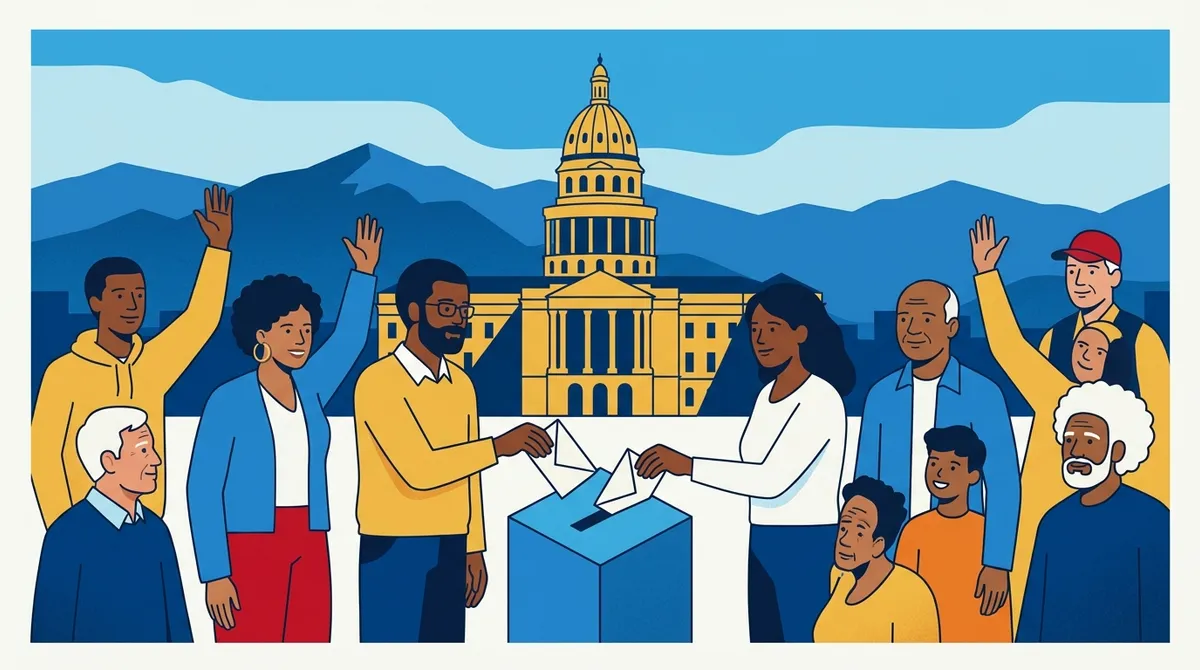
Campaign Finance Reform: Get Big Money Out of Denver Politics
Denver already has a tool to track money in politics. Now we need reform: lower contribution limits, LLC disclosure, and a small-dollar matching program so working Denverites can compete with corporate donors.
- Drafted
- Organizing
- Introduced
- Committee
- Enacted
The Problem
Denver tracks money in politics. This platform has a tool for it. But tracking is not reforming.
Every election cycle, Denver’s disclosure system shows the same pattern: candidates who raise more money, primarily from a small number of large donors, win more often. Developers, real estate interests, downtown business associations, and corporate PACs write checks that individual voters cannot match. Those donors get calls returned. Their concerns get heard. Their preferred policies get advanced.
This is not corruption in the legal sense. In Denver, it is perfectly legal. That is the problem.
The Current System
Denver’s campaign finance rules permit individual contributions of up to $10,000 to a mayoral candidate per election (Denver Campaign Finance Ordinance, 2024). For City Council races, the limit is $2,000. These limits are not indexed to average wages or household income. They are indexed to nothing - they simply reflect what the incumbent political class found acceptable when the rules were last updated.
The result is a system where:
- Candidate viability is determined by access to large donors. Before the first vote is cast, the “money primary” weeds out candidates who cannot quickly raise $500,000-$1M+ from wealthy networks. Candidates from working-class backgrounds, without established donor networks, face a structural barrier that has nothing to do with their ideas or their community support.
- LLC and corporate bundling obscures the real sources of money. Under current rules, a real estate developer can funnel contributions through multiple LLCs, each making a $10,000 contribution, with no requirement that the beneficial owner be disclosed. The public sees a list of entities; they cannot see the person.
- Small-dollar donors are irrelevant. A $50 donation from a Denver worker has exactly the same political signal as a $50 donation in any other system: none. There is no mechanism to amplify the voice of small donors relative to large ones.
What the Money Primary Produces
The 2023 Denver mayoral election is instructive. The two candidates who advanced to the runoff - Mike Johnston and Kelly Brough - were also the two candidates who had raised the most money, primarily from real estate developers, corporate PACs, and a small number of wealthy individuals. Both ran as pro-business, pro-development moderates. The platform of the large donor class was well-represented. The platform of Denver’s renter majority was not.
This outcome is not coincidental. The money primary filters candidates before the voter primary. When the electorate finally votes, it is choosing among candidates pre-selected by the donor class.
Our Solution
1. Lower Contribution Limits
Reduce the maximum individual contribution to Denver city elections:
| Race | Current Limit | Proposed Limit |
|---|---|---|
| Mayor | $10,000/election | $2,500/election |
| City Council | $2,000/election | $1,000/election |
| School Board | $2,000/election | $1,000/election |
These limits are still generous by the standards of most democracies. A household earning Denver’s median income ($75,000) could give 3% of its annual income at the proposed mayoral limit. The current limit requires 13%.
Candidates who cannot win with $2,500 checks have access to a broader donor base - or they haven’t built the community support to justify the office.
2. LLC and Corporate Bundling Disclosure
Require beneficial owner disclosure for all contributions from LLCs, partnerships, and other non-natural-person entities:
- Any contribution from an LLC or partnership must include the name and address of all individuals with an ownership stake of 10% or more.
- Disclosed beneficial owners count toward individual contribution limits - a developer cannot contribute $10,000 through four LLCs and claim four separate limit allowances.
- Violations are subject to treble fines: three times the contribution amount.
This is not a ban on organizational giving. It is a requirement that the public know who is actually funding campaigns.
3. Small-Dollar Matching Program
Create a Denver Democracy Fund - a public small-dollar matching program:
- For every dollar raised by a candidate from a Denver resident in contributions of $50 or less, the Democracy Fund contributes $6 (a 6:1 match).
- Eligible contributions: individual Denver residents only, no minimum, $50 maximum per donor per election.
- Participation is voluntary. Candidates who participate must agree to: the lower contribution limits above, an overall spending cap indexed to district size (~$300K for council, ~$2M for mayor), and enhanced disclosure.
- A candidate is eligible to participate once they demonstrate community support: 200 qualifying donors for council races, 1,000 for mayor.
The effect: A candidate who raises $50,000 from 1,000 small donors receives $300,000 from the matching fund - a total of $350,000 with no single large check. They are competitive with a candidate who raises $500,000 from 50 large donors under the current system. The incentive structure changes: instead of attending donor dinners, candidates knock doors. Instead of calling wealthy individuals, they organize communities.
New York City has operated a version of this program since 1988. The 2021 NYC elections, using a 7:1 match, produced:
- 61% increase in small-dollar donors relative to the previous cycle (NYC CFB, 2022)
- 31% increase in first-time candidates from working-class backgrounds
- More racially diverse candidate field
- Winners who raised proportionally more of their funding from small donors
4. Independent Campaign Finance Oversight Board
Denver’s current campaign finance enforcement is handled by the Denver Elections Division, a city agency that reports to the Mayor. This structural conflict - the Mayor’s office enforcing finance rules on candidates for Mayor - creates at minimum an appearance problem and at most an enforcement problem.
Create an independent, five-member Campaign Finance Oversight Board:
- Members appointed by the City Council, confirmed by the Mayor, but serving staggered 5-year terms with removal only for cause.
- Authority to investigate violations, issue fines, refer criminal violations to the DA’s office, and publish enforcement reports.
- Staffed by attorneys independent of any city department.
- Public complaint process: any Denver resident can file a complaint with a 30-day response requirement.
5. Real-Time Disclosure
Current disclosure deadlines allow large contributions to be made and remain undisclosed until after the election. Require:
- 48-hour disclosure of all contributions over $1,000 in the final 30 days before an election.
- Real-time disclosure (within 24 hours) for contributions over $2,500 at any time during an election cycle.
- All disclosure data published in machine-readable format (not just PDFs) so journalists, researchers, and civic technologists can analyze and visualize the data.
- The city’s existing money-in-politics tracking tool (see: this platform’s Campaign Finance tool) should be officially integrated with the disclosure system to provide real-time public visualization.
Evidence
Small-Dollar Matching Works
The evidence base for small-dollar matching programs is strong and growing:
| Program | Key Outcome |
|---|---|
| NYC (since 1988, 7:1 since 2021) | 61% more small donors in 2021; significantly more diverse candidate field; winners raised more from small donors (NYC CFB, 2022) |
| Connecticut (statewide, since 2008) | Dramatically reduced large-donor influence in state legislative races; more contested primaries; increased candidate diversity (Malbin et al., 2012) |
| Montgomery County, MD (6:1) | 50%+ increase in participating candidates; dramatic shift in donor composition toward small donors (Montgomery County CFB, 2020) |
Contribution Limits and Corruption
Research consistently shows that higher contribution limits correlate with stronger perceptions of corruption and lower public trust in government (Primo & Milyo, 2006; La Raja & Schaffner, 2015). Lower limits do not reduce political speech - they shift whose speech is amplified.
Denver’s Own Data
An analysis of the 2023 Denver mayoral election (Denver Campaign Finance disclosures) shows:
- The top 50 donors to the top two candidates contributed more money than the bottom 2,000 donors combined.
- More than 60% of all mayoral campaign funds came from contributions of $500 or more.
- The two candidates who spent the most money advanced to the runoff.
Local Context
Denver’s political economy has a specific structure. A relatively small number of entities - large real estate developers, the Denver Metro Chamber of Commerce, a handful of healthcare and energy corporations, and a network of wealthy individuals - provide a disproportionate share of campaign funding for Denver elections. These are also the entities with the most at stake in Denver’s policy decisions on zoning, development, taxation, and labor.
This creates a structural alignment between campaign funding and policy outcomes that operates below the level of explicit quid pro quo. Elected officials do not need to promise specific favors to specific donors. They simply absorb, over years of fundraising relationships, an understanding of what concerns their donors and what concerns are worth prioritizing.
Campaign finance reform does not eliminate this dynamic. But it dilutes it - by making the candidate who appeals to thousands of small donors as competitive as the candidate who appeals to dozens of large ones.
Frequently Asked Questions
“Isn’t campaign finance protected by the First Amendment?” The Supreme Court’s campaign finance jurisprudence is complex, but contribution limits are well-established as constitutional. Every state and locality that operates contribution limits - which is almost all of them - does so lawfully. The proposed limits are higher than those in many comparable cities. The small-dollar matching program is entirely voluntary and has been upheld in every jurisdiction where it has been challenged.
“What about independent expenditures? Won’t big money just move to PACs?” Yes, partially. Independent expenditures (Super PAC-style spending) are constitutionally protected under Citizens United and cannot be limited. But the evidence from matching program jurisdictions shows that amplifying small donors still changes candidate behavior and candidate selection - even when independent expenditures remain. Candidates in matching programs spend more time with ordinary constituents and less time with major donors, regardless of what outside groups spend.
“Won’t this just mean taxpayer money goes to fringe candidates?” No. The qualifying threshold (200 contributors for council, 1,000 for mayor) ensures candidates demonstrate genuine community support before accessing matching funds. New York City’s program has operated for 35+ years without producing significant abuse. The spending cap limits the total public exposure per candidate.
How We Pay For It
| Item | Annual Cost |
|---|---|
| Denver Democracy Fund (matching program) | ~$4-6M per election cycle |
| Campaign Finance Oversight Board | ~$750K/year |
| Enhanced disclosure technology | ~$250K one-time, ~$100K/year maintenance |
The Democracy Fund is capitalized through a new line item in the city budget, with the option of a small dedicated levy on campaign advertising revenue. At $4-6M per 4-year election cycle, this is approximately $1-1.5M/year - a small price for a functioning democracy.
References
- Denver Campaign Finance Ordinance. City and County of Denver, 2024.
- La Raja, R. & Schaffner, B. Campaign Finance and Political Polarization. University of Michigan Press, 2015.
- Malbin, M. et al. Small Donors, Big Democracy. The Campaign Finance Institute, 2012.
- Montgomery County Campaign Finance Board. Annual Report. 2020.
- New York City Campaign Finance Board. Annual Report. 2022.
- Primo, D. & Milyo, J. Campaign Finance Laws and Political Efficacy. Election Law Journal, 2006.
El Problema
Denver rastrea el dinero en la política. Esta plataforma tiene una herramienta para ello. Pero rastrear no es reformar.
Cada ciclo electoral, el sistema de divulgación de Denver muestra el mismo patrón: los candidatos que recaudan más dinero, principalmente de un pequeño número de grandes donantes, ganan con más frecuencia. Los promotores, los intereses inmobiliarios, las asociaciones empresariales del centro y las PAC corporativas escriben cheques que los votantes individuales no pueden igualar.
El Sistema Actual
Las reglas de financiamiento de campañas de Denver permiten contribuciones individuales de hasta $10,000 a un candidato a la alcaldía por elección. El resultado es un sistema donde la viabilidad del candidato está determinada por el acceso a grandes donantes, los grupos de LLC y la agrupación corporativa ocultan las fuentes reales del dinero, y los pequeños donantes son irrelevantes.
Nuestra Solución
1. Reducir los Límites de Contribución
| Cargo | Límite Actual | Límite Propuesto |
|---|---|---|
| Alcalde | $10,000/elección | $2,500/elección |
| Concejo Municipal | $2,000/elección | $1,000/elección |
| Junta Escolar | $2,000/elección | $1,000/elección |
2. Divulgación de LLC y Agrupación Corporativa
Requerir la divulgación del beneficiario final para todas las contribuciones de LLC, sociedades y otras entidades no personales. Los propietarios beneficiarios divulgados cuentan para los límites de contribución individuales.
3. Programa de Correspondencia de Pequeñas Donaciones
Crear un Fondo de Democracia de Denver:
- Por cada dólar recaudado de un residente de Denver en contribuciones de $50 o menos, el Fondo aporta $6 (correspondencia 6:1).
- La participación es voluntaria con límites de gasto más bajos y mayor divulgación.
- Umbral de elegibilidad: 200 donantes calificados para carreras del consejo, 1,000 para alcalde.
El efecto: Nueva York ha operado este programa desde 1988. Las elecciones de 2021 con correspondencia 7:1 produjeron un 61% más de pequeños donantes y un 31% más de candidatos por primera vez de entornos de clase trabajadora (NYC CFB, 2022).
4. Junta de Supervisión de Financiamiento de Campañas Independiente
Crear una Junta de Supervisión de Financiamiento de Campañas independiente de cinco miembros con autoridad para investigar violaciones, imponer multas y publicar informes de cumplimiento, independiente del departamento de la ciudad del Alcalde.
5. Divulgación en Tiempo Real
- Divulgación en 48 horas de todas las contribuciones superiores a $1,000 en los últimos 30 días antes de una elección.
- Divulgación en tiempo real (dentro de 24 horas) para contribuciones superiores a $2,500.
- Todos los datos de divulgación publicados en formato legible por máquina.
Evidencia
| Programa | Resultado Clave |
|---|---|
| Nueva York (desde 1988, 7:1 desde 2021) | 61% más de pequeños donantes en 2021; campo de candidatos más diverso (NYC CFB, 2022) |
| Connecticut (estatal, desde 2008) | Influencia de grandes donantes dramáticamente reducida; más primarias disputadas (Malbin et al., 2012) |
| Condado de Montgomery, MD (6:1) | Aumento del 50%+ en candidatos participantes (Junta de Finanzas de Campaña de Montgomery, 2020) |
Contexto Local
La economía política de Denver tiene una estructura específica: un número relativamente pequeño de entidades, grandes promotores inmobiliarios, la Cámara de Comercio del Metro de Denver, y una red de personas adineradas, proporciona una parte desproporcionada del financiamiento de campañas para las elecciones de Denver.
Preguntas Frecuentes
“¿No está el financiamiento de campañas protegido por la Primera Enmienda?” Los límites de contribución están bien establecidos como constitucionales. Casi todos los estados y localidades operan límites de contribución legalmente.
“¿No irá el dinero grande simplemente a las PAC independientes?” Parcialmente. Pero la evidencia de las jurisdicciones con programas de correspondencia muestra que amplificar a los pequeños donantes aún cambia el comportamiento de los candidatos y la selección de candidatos.
Cómo Lo Financiamos
| Elemento | Costo Anual |
|---|---|
| Fondo de Democracia de Denver | ~$4-6M por ciclo electoral |
| Junta de Supervisión de Financiamiento de Campañas | ~$750K/año |
| Tecnología de divulgación mejorada | ~$250K único, ~$100K/año mantenimiento |
Referencias
- Ordenanza de Financiamiento de Campañas de Denver. Ciudad y Condado de Denver, 2024.
- La Raja, R. y Schaffner, B. Campaign Finance and Political Polarization. University of Michigan Press, 2015.
- Malbin, M. et al. Small Donors, Big Democracy. The Campaign Finance Institute, 2012.
- Junta de Finanzas de Campaña de la Ciudad de Nueva York. Informe Anual. 2022.
- Primo, D. y Milyo, J. Campaign Finance Laws and Political Efficacy. Election Law Journal, 2006.